
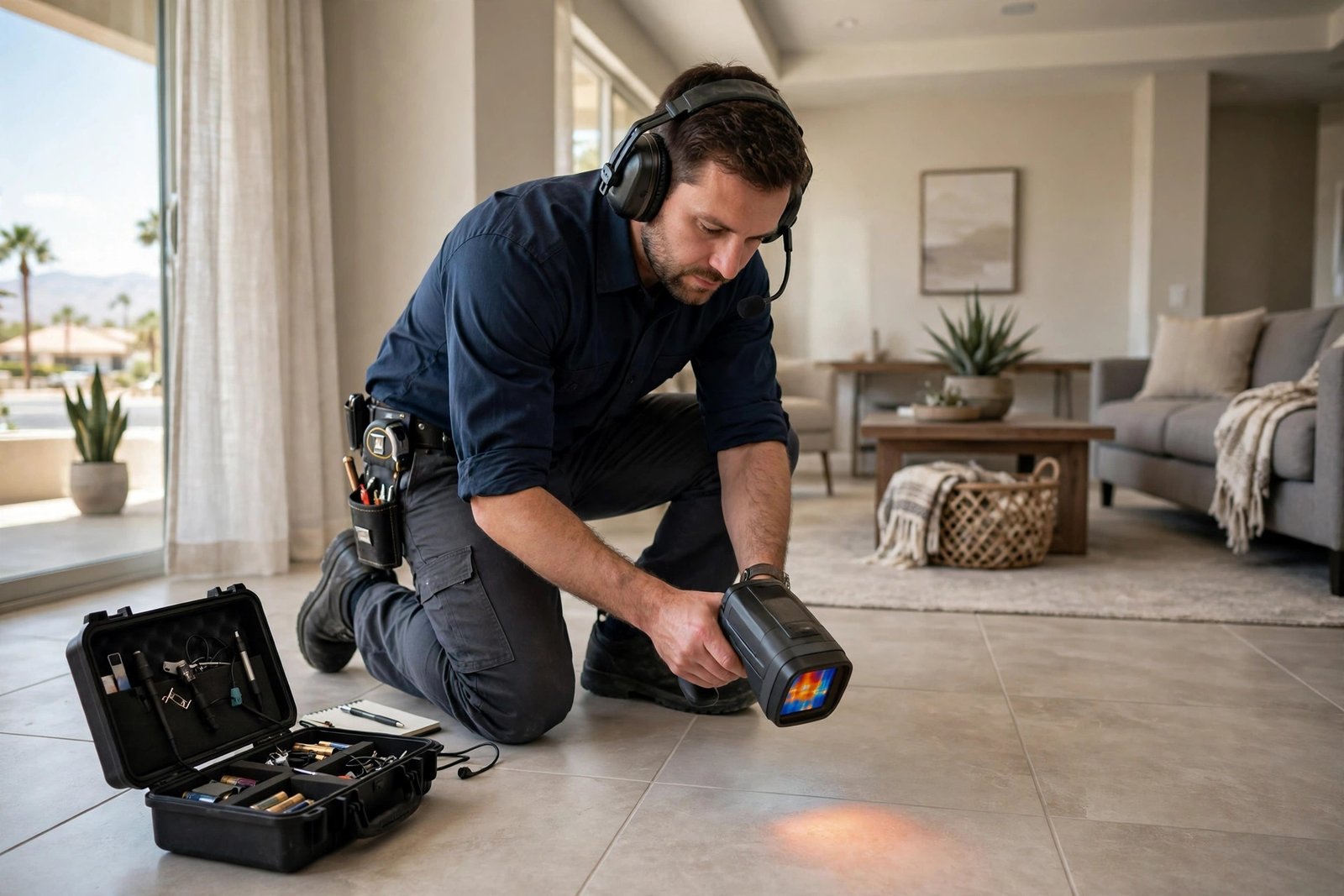
Most Las Vegas homes sit on a concrete slab, and the water lines run under it. A leak there does not show as a puddle. It shows as a warm patch on the tile, a water bill that jumps for no reason, or the sound of running water when every tap is off. Slab leak detection finds the exact spot with listening gear and thermal imaging, so only the smallest needed section of floor is opened. If you are looking for slab leak detection Las Vegas, this page covers the process, the price guidance, and how to get help.
Slab Leak Detection Las Vegas: Signs of a slab leak
A warm or damp spot on a hard floor is the classic sign, usually over a hot water line. A water bill that climbs while usage stays the same is another. So is a water meter that keeps turning when every tap and appliance is off. Low pressure at one fixture, a musty smell near the floor, or a crack in tile or flooring can also point to a slab leak. Any one of these is worth a check, because a slab leak left running erodes soil under the slab and damages flooring from below.
How detection works
First, the meter test: all water use is shut off and the meter is watched. A moving meter means water is leaving the system somewhere. Next, acoustic listening gear picks up the sound of the leak through the floor, and a thermal camera shows the warm plume from a hot line leak. The two readings together narrow the spot to a small area. Only then is the floor opened, and only at that spot. This is the difference between a repair that opens a few tiles and a repair that tears up a room on a guess.
Repair options
Once the leak is found, the options are a direct repair at the spot, or a reroute of that line through the wall or ceiling so the under-slab section is abandoned. A direct repair is usually the smaller job. A reroute suits a line that has leaked before or shows more weak points, and it avoids opening the floor again later. Both are priced before work starts, with the trade-offs explained in plain terms.
Slab Leak Detection Las Vegas: What it costs
A slab leak repair in Las Vegas usually lands between $1,000 and $4,000, depending on the location, the repair method, and the flooring that must be restored. Detection is part of the job, not an extra surprise. The price is confirmed before the floor is opened, so there is no open-ended digging on your bill.
Why slab leaks are common in Las Vegas
Slab construction is the standard across the valley, so almost every home has lines under concrete. Hard water at 16 to 22 grains per gallon scales and corrodes lines over time, and older copper lines under a slab can develop pinhole leaks after decades in contact with concrete and soil. Summer ground temperatures add expansion stress. None of this means every home will get a slab leak, but it means the signs above are worth acting on rather than watching.
| Question | Answer |
|---|---|
| How do I check for a slab leak myself? | Turn off every tap and appliance, then watch the water meter. If it keeps moving, water is leaving the system somewhere and a detection visit is the next step. |
| Will my whole floor be torn up? | No. Listening gear and thermal imaging locate the leak first, so only the smallest needed section is opened. |
| How much does slab leak repair cost? | Usually between $1,000 and $4,000, depending on location, method and flooring restoration. The price is confirmed before work starts. |
| Is a reroute better than a direct repair? | A direct repair is smaller. A reroute suits a line that has leaked before or has more weak points, and it avoids opening the floor again later. |
| Can a slab leak wait? | It should not. A running leak erodes soil under the slab and damages flooring, and the water bill keeps climbing while it runs. |
| Does insurance cover slab leak repair? | That depends on the policy. The detection report and repair notes can be provided for a claim, and the wording of the policy decides the rest. |
Slab Leak Detection Las Vegas: Get a slab leak checked
Use the contact form. Say what you noticed: a warm spot, a bill jump, a moving meter, or the sound of running water. Those details point the detection straight at the problem.